By the time most artists are figuring out their second act, Rob Zombie has already burned through several lives, each more unhinged and theatrical than the last. From the grimy Lower East Side birth of White Zombie in the mid‑’80s to his solo horror‑metal dominion in the 2020s, Zombie’s career reads like a grindhouse reel spliced with arena‑ready riffs and industrial grit.
From Art School Freak to White Zombie Overlord
The story starts in 1985, when Rob (then Rob Cummings) and bassist Sean Yseult stitched together White Zombie out of New York’s underground art‑punk noise. This wasn’t polished metal; it was a sewer‑born hybrid of punk, noise rock, and B‑movie obsession, lurching forward on distortion and bad intentions. Their 1987 debut “Soul‑Crusher” sounded like a haunted basement show captured on a cursed cassette, already hinting at the cinematic horror fetish that would define Zombie’s entire universe.
By 1989’s “Make Them Die Slowly,” White Zombie began mutating into something heavier and more focused, still filthy, but sharpening its claws. The real transformation hit in 1992 with “La Sexorcisto: Devil Music Vol. 1,” when “Thunder Kiss ’65” crashed into MTV and Headbangers Ball like a psychotic grindhouse car chase set to groove metal. The band’s lurid visuals, exploitation‑film samples, and swing‑for‑the‑head riffing suddenly had a mainstream pulpit, turning their once niche horror aesthetic into a pop‑culture virus.
Then came 1995’s “Astro‑Creep: 2000 – Songs of Love, Destruction and Other Synthetic Delusions of the Electric Head,” the moment White Zombie evolved into full‑scale industrial groove juggernaut. “More Human than Human” was everywhere—strip clubs, radio, movie trailers—its slide‑riff and robotic churn becoming one of the defining metal tracks of the ’90s. But just as the band hit peak velocity, the engine died; by the late ’90s, White Zombie quietly disintegrated, leaving Rob standing alone amid the wreckage, covered in neon corpse paint and ready for his next incarnation.
The Birth of Hellbilly Deluxe
In 1998, Rob Zombie walked out of the band graveyard and into his solo era with “Hellbilly Deluxe: 13 Tales of Cadaverous Cavorting Inside the Spookshow International,” a title that reads like a manifesto and sounds like a threat. The album hit like an industrial‑laced carnival from hell—riff‑heavy, sample‑soaked, and precision‑built for both mosh pits and midnight horror marathons. “Dragula,” “Living Dead Girl,” and “Superbeast” didn’t just become singles; they became modern horror‑rock standards, woven into soundtracks, wrestling entrances, and every October playlist worth a damn.
At the same time, Zombie doubled down on his curator of creep persona with his own label, Zombie‑A‑Go‑Go, and releases like “Halloween Hootenanny,” further blurring the lines between musician, horror historian, and ringmaster of all things spooky and sleazy. This wasn’t a rock star dabbling in horror; it was a horror obsessive using rock as his loudest megaphone.
Sinister Urges and Mutant Evolution
If “Hellbilly Deluxe” was the explosion, 2001’s “The Sinister Urge” was the shockwave rolling out across the early 2000s. Tracks like “Feel So Numb” and “Never Gonna Stop (The Red, Red Kroovy)” proved that Zombie could weaponize hooks as ruthlessly as he did atmosphere, delivering a record that felt bigger, slicker, and designed for maximum impact without sacrificing the monster‑movie soul. A 2003 compilation, “Past, Present & Future,” framed his trajectory as something larger than a single band or album—a whole evolving horror mythology built across decades.
In 2006, “Educated Horses” threw some fans a curveball. The album stripped back some of the thick industrial armor in favor of a more straightforward hard‑rock stomp, still grimy, still sinister, but with a slightly more classic rock backbone beneath the grime. It sounded like Zombie testing the edges of his own formula, pulling the camera back a bit to see what else his world could hold.
A year later, “Zombie Live” captured his stage show in its natural habitat: loud, theatrical, and dripping with visual excess. For anyone who’d only experienced these songs in headphones, the live record laid it bare—this was arena‑sized horror theatre masquerading as a metal set.
Hellbilly Returns, Radio Mutants, and Remix Carnage
By 2010, the circle turned back with “Hellbilly Deluxe 2: Noble Jackals, Penny Dreadfuls and the Systematic Dehumanization of Cool,” a sequel in both name and spirit. The record leaned again into that maximalist, carnival‑of‑freaks energy, like a rusted funhouse mirror reflecting the original “Hellbilly Deluxe” through a decade’s worth of scars.
Zombie’s catalog proved weirdly suited for mutation, which made 2012’s “Mondo Sex Head” almost inevitable—a full remix album that dragged his riffs onto the dance floor, filtered through electronic, industrial, and club sensibilities. It was a reminder that beneath the blood, guts, and B‑movie samples, these songs had a pulse strong enough to survive dismemberment and reconstruction.
2013’s “Venomous Rat Regeneration Vendor” pushed that sense of mutant evolution even further. “Dead City Radio and the New Gods of Supertown” felt like a broadcast from a blasted future, equal parts sermon and static, while his swaggering cover of “We’re an American Band” slammed classic rock bravado into his own techno‑occult circus. It was both homage and hijacking.
Electric Warlocks and Lunar Conspiracies
By the mid‑2010s, many of Zombie’s peers were coasting on nostalgia. He did the opposite: he went weirder. 2016’s “The Electric Warlock Acid Witch Satanic Orgy Celebration Dispenser” condensed all his obsessions into a short, brutal blast of cartoonishly titled, over‑the‑top tracks. It played like a grindhouse feature cut down to its sharpest, bloodiest scenes—no filler, just spectacle and swagger.
In 2021, “The Lunar Injection Kool Aid Eclipse Conspiracy” proved he still had serious chart gravity, landing in the U.S. Top 10 while sounding deranged in all the right ways. The album fused groove‑heavy riffs, warped samples, and off‑kilter structures into something that felt like a late‑night broadcast from some cult’s pirate station, declaring that the apocalypse would come with a stomping backbeat. For an artist nearly four decades deep, this wasn’t legacy victory‑lap material; it was still feral, still hungry.
Punks, Demons, and The Great Satan
Rather than slowing down in the mid‑2020s, Zombie leaned into his mythos even harder. In 2025, he kicked off a new cycle with fresh material teased through singles like “Punks and Demons,” signaling that the tanks of groove and grime were nowhere near empty. These songs felt like a continuation of the same twisted sermon he’s been preaching since the White Zombie days—outsiders, monsters, and freaks finding their soundtrack in fuzzed‑out riffs and occult‑TV static.
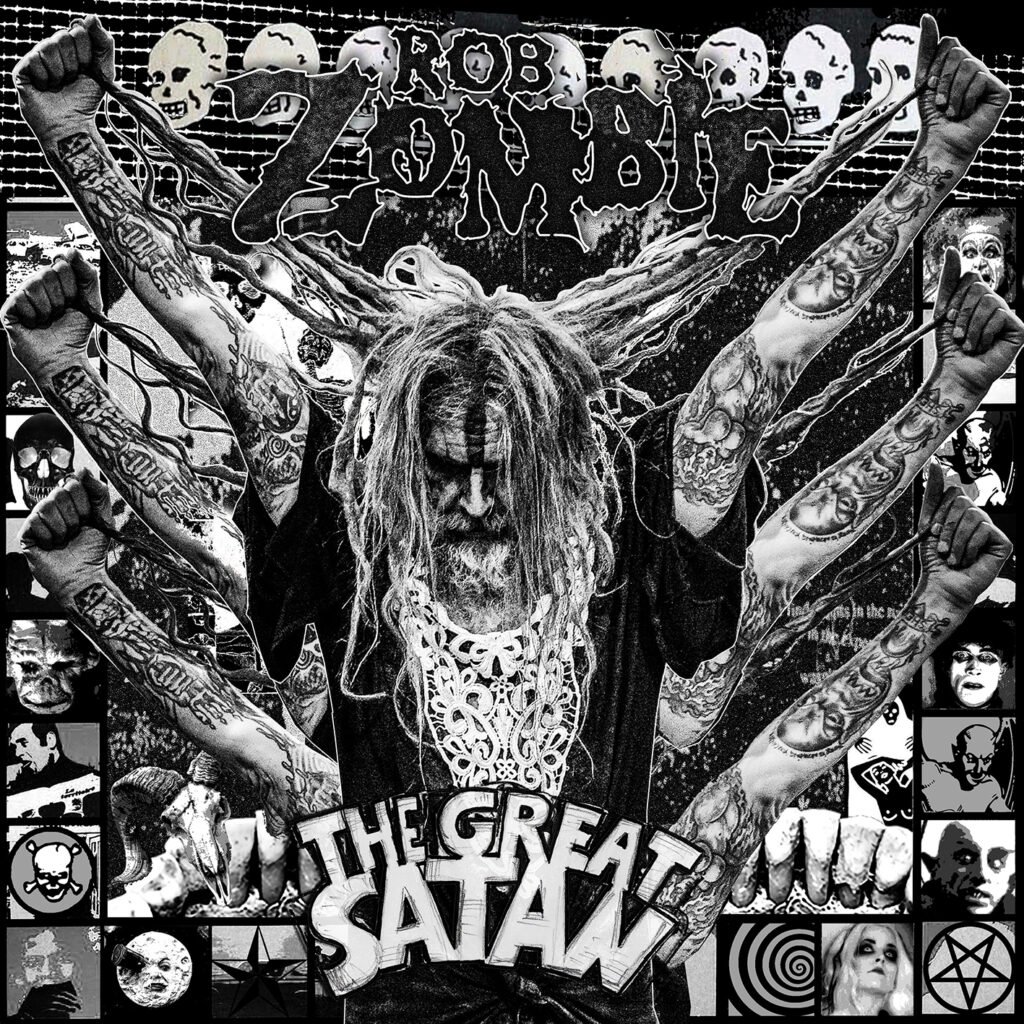
By 2026, that momentum culminated in the release of “The Great Satan” on Nuclear Blast Records, a label whose roster fits his aesthetic like a spiked glove. With tracks like “(I’m a) Rock ’n’ Roller,” Zombie doubled down on his role as horror‑rock lifer, a showman who never walked away from the circus, just kept repainting the tents in ever‑brighter blood. The record doesn’t read like a reinvention so much as a reaffirmation: this is who he is, and this is the noise he makes until the reels finally burn out.
The Never‑Ending Spookshow
Across four decades, Rob Zombie has done more than just release albums; he’s built a contiguous, cross‑media nightmare carnival that spans bands, solo records, tours, and film. The throughline is unmistakable: groove‑driven heaviness, grindhouse obsession, and a refusal to separate horror from rock ’n’ roll. From the grimy squall of “Soul‑Crusher” to the slick, apocalyptic stomp of “The Great Satan,” every era feels like another chapter in the same cursed comic book.
For the outsider kids, the horror nerds, the late‑night channel surfers who grew up on scratched tapes and flickering VHS covers, Zombie’s discography is more than background noise. It’s a sanctuary built out of riffs, monsters, and neon graveyards—a reminder that in his world, the freaks don’t just come out at night. They headline.